

Hey there,
I know it has been a while since I sent a newsletter. The last few months have been chaos with house moving/renovating, but I am starting to get back on my feet.
I am aiming to publish a weekly newsletter each Saturday for you to read over the weekend with a deep dive into competition climbing and some updates. This one is a little late due to prepping for Keqiao becoming a bigger task than I had imagined and this newsletter became much longer than expected.
This week, I write about my experience at the Pro Climbing League London event which was held back in February.
I discuss my feelings about the event and what the athletes thought of it. I also look deeper at whether the new format was "speed bouldering", something Charlie was adamant in our interview they wanted to avoid. Finally, I include an interview with Head Routesetter at the event Sergio Verdasco from the day before the competition.
I finish off with a short recap of the biggest news over the past few months, some media I've enjoyed recently, and a ticket update as usual.
If you would like to support me and independent journalism, please donate here. I really appreciate it.
The quotes throughout have been lightly edited for clarity.
What I Thought About the PCL Event
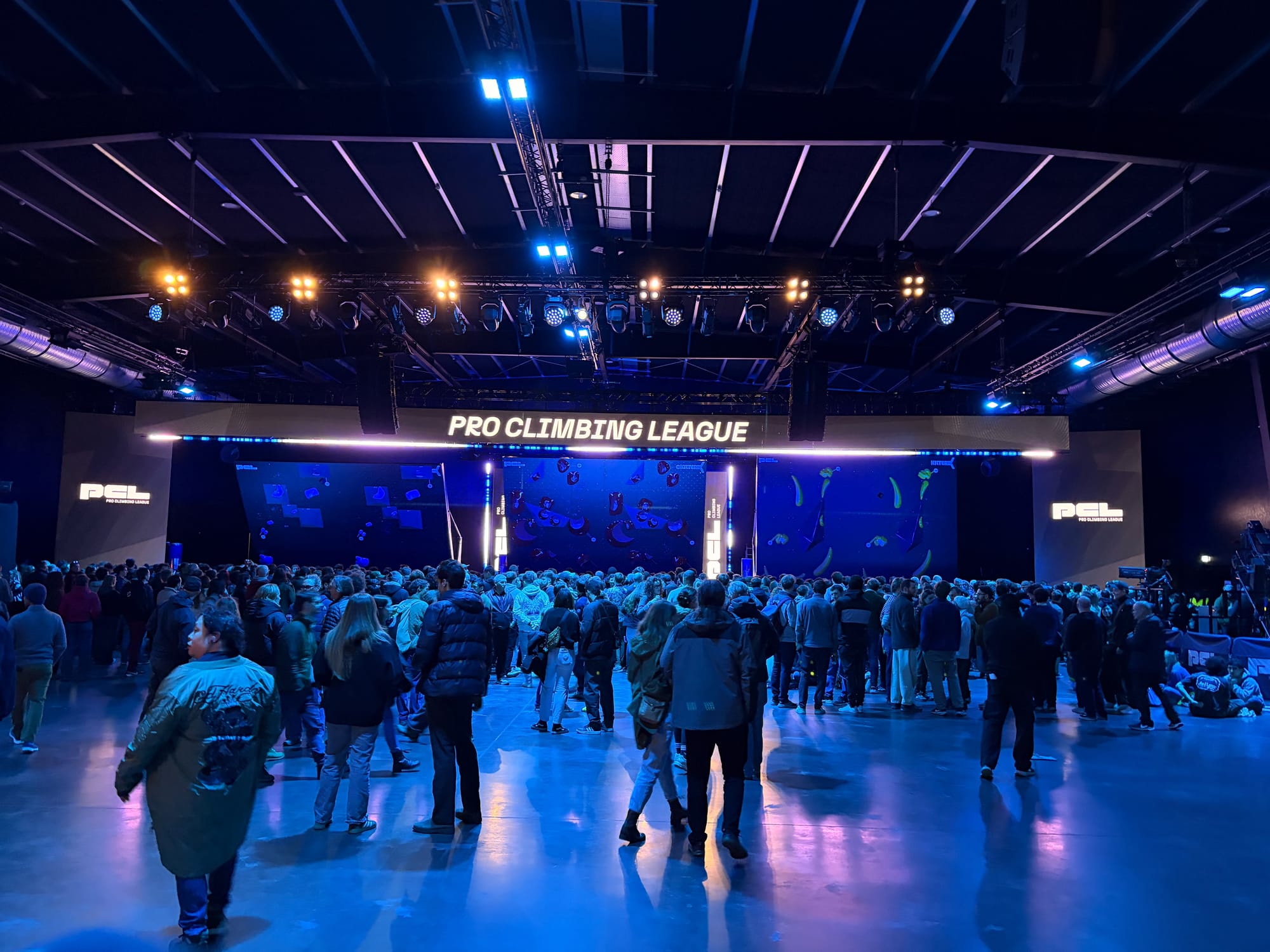
The fact Charlie and Danaan got to this point is an incredible achievement.
To run a climbing competition event with 16 of the best climbers in the world, streamed on Red Bull TV, from a premier venue in London, after selling out over 2000 tickets in a day.
Whatever you think of the format and the event, the climbing world is better off for PCL London happening.
The event felt like a spectacle and the polar opposite of what the World Climbing (previously IFSC) competitions have become. World Climbing has pared back the events further and further, even having two climbers climbing at a time, with very little time for storytelling and interviews. The storytelling is left to the commentators alone with little support.
PCL London went to the other extreme, taking the format of a traditional sports broadcast and slotting in 45 minutes (45 minutes and 3 seconds exactly) of climbing inside a 3.5 hour plus broadcast. The extra time is filled out with storytelling, interviews, and all the colour coverage that World Climbing has stripped out to fit the Eurosport TV schedule. This contrasts with a World Cup final having at nearly 80 minutes of climbing in a 2.5 hour slot, even less if you leave before the medal ceremony. The PCL did start to drag in person, with the time between the duels (what i'm calling each pairing) starting to feel extra long, especially when compared to World Cups which send athletes out as fast as possible. Maybe this worked better on the stream, but in person seeing the athlete introductions each time started to drag.
The men's final between Colin Duffy and Max Milne saved the event and showed what the format could be. It was incredible to watch in person and feel the energy ofthe crowd. Seeing Max Milne break the boulder with blood on his hands was phenomenal, and a perfect sporting moment.
The moment also showed one of the weaknesses of the format, with more straightforward physical boulders meaning we didn't see alot of athletes exploring different beta on the climbs, which is my favoruite part about World Cup boulders. Had Max not "broken" the boulder, the final would have been decided by a "race" to the second hold, which Colin won early on after a false start by Max.
The women's final felt completely different. It was a big let down, with the two athletes we came to see, Janja Garnbret and Oriane Bertone, competing on an boulder that was too easy and Janja fell on the early coordination move. She was left watching Oriane top out the boulder and the duel we had waited for over 3 hours for was done in 20 seconds. Yes, that is the format, but I want to see more climbing from the best.
On the PCL debrief podcast with Tyler Norton and Natalie Berry, Tyler suggested switching the best-of-3 format for qualification with the final to increase the amount of climbing we saw from the best competitors, which I am completely onboard with.
It was a good first event, and I hope we see more of them. There are obvious things to improve and I hope the PCL crew get a chance to do so.
What was the media experience like?
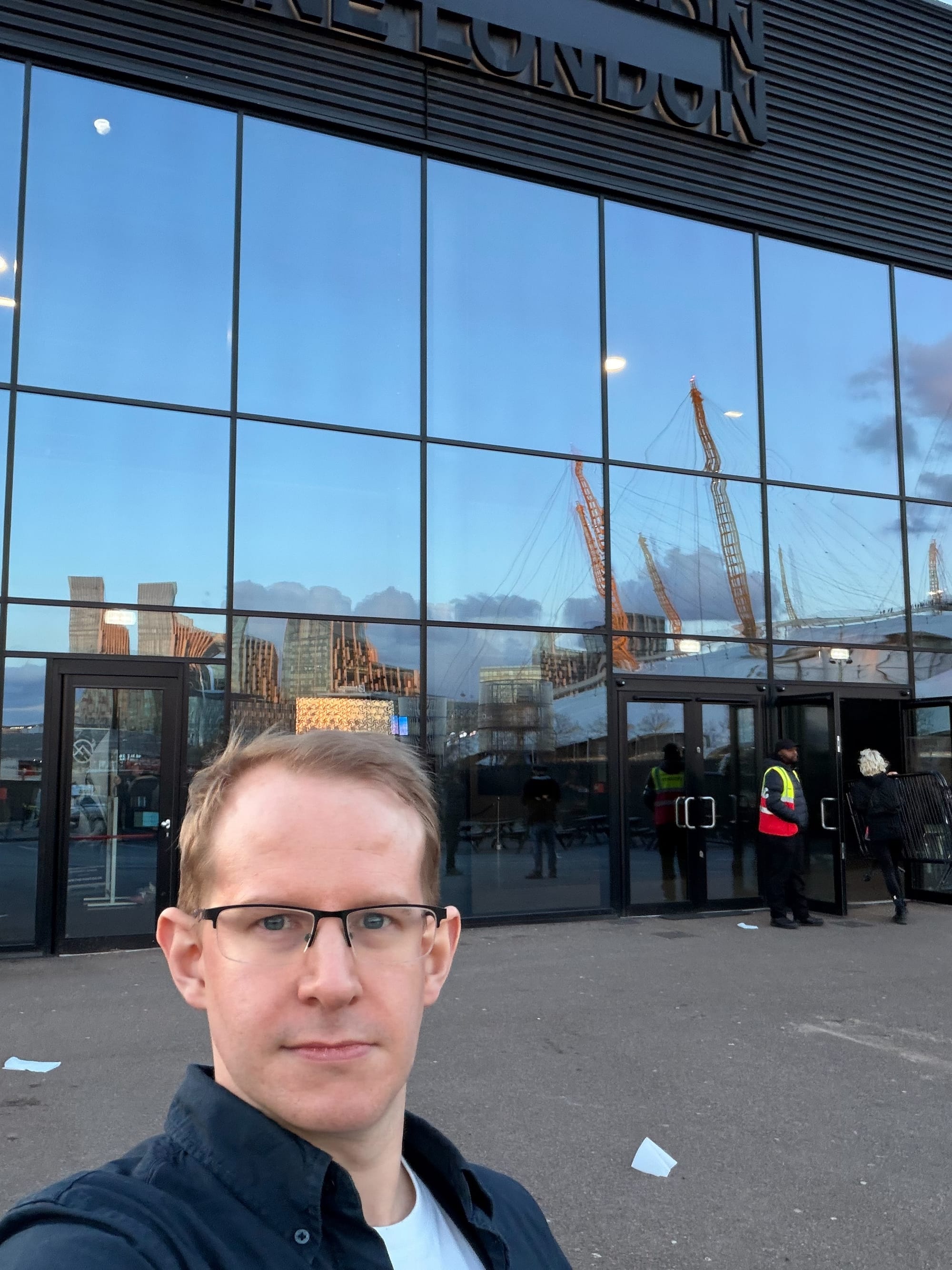
I was lucky enough to spend two days in London covering the event.
The first day was a creative day, where creators and Red Bull got to interview athletes before the seeding round in the evening. This was amazing and the best experience I've had as media at a climbing competition (and I've been to seven now).
Please PCL, do this again.
The athletes were prepped and engaged, and the media team Matt and Teresa did a stellar job herding the cats which are creators and athletes. During this time, I got to interview the athletes in a relaxed environment completely different from the chaos of a World Cup. I also got to meet many of the YouTube creators I admire and it was nice to not be the only media at a climbing event for once. Go and watch Hannah Morris's video asking climbers the most searched questions to see what came out of it. I'll be putting out some reels on Instagram over the next few months from the chats I had.
The seeding round that followed was one of the most special competitions to watch, and we got to watch from the edge of the mats. It was intimate in a way a broadcasted competition could never be. The round was clearly aimed at the VIPs to give them a feeling for how great a climbing competition could be and the round delivered.
Day one was the best media experience I've had at a climbing competition. Day two was a return normality, with the media reduced to second class citizens like at most competitions. We didn't have a media room, relying on trusting our kit would be safe on the mezzanine next to the VIP level (which was guarded), but had no coffee, no snacks, and it was an awkard place to work. We also got kicked out immediately instead of allowed to finish off our coverage before leaving.
We had an access-band mix up with the organizers and security getting different briefings from the venue (I had a different band mix up at the Innsbruck World Cup last year as well, so World Climbing events aren't immune). Matt, Teresa and Danaan were great at getting this resolved quickly, but things like this shouldn't happen.
The place to interview athletes after each round while the routesetting reset was going on was in what I assume was a band green room which felt like a closet. We only had the time it took the routesetters to reset the wall to get interviews, so the 4 of us interviewing athletes got a minute each.
But at least we got to talk to them, something that barely ever happens at World Cups as athletes avoid the media area and head off into the night except for those World Climbing wanted to interview from the podium.
So in all, the experience was better than at World Cups for me as media. There are still things to improve, but it was a definite improvement over the World Climbing events.
How did the athletes find the event?
Most of the athletes we got to talk to after the rounds really enjoyed the format. Jenny Buckley said:
“I think I'm made for competitions like this. I kind of like the, like, I think I soak in the energy in a really positive way. Yeah, I'm a risk taker you know. I think maybe too much today, but I don't think I'll change my method. I think I just like for hopefully future comps, PCL. I think I'll keep this base, which, like, it's slowly and risky. You know, I just might have to do fine tuning with like details. Maybe too many mistakes, but, you know, I want to learn from this comp because I'm not gonna be falling out in first rounds next time, I hope. Yeah, it's not the plan.”
Jenny also really liked the head-to-head format:
“Yeah, I think like that's gonna create really a cool dynamic between us athletes. Like, you know, obviously for just this time, like you probably follow MMA fights or UFC fights. I think it could be so. And I think it's awesome. Like, honestly, we can trash talk like we're friends. So I think it would be fun.”
The crowd was a common talking point. 2024 Olympic Champion Toby Roberts said:
“I think the best part of this experience was again just the atmosphere and how much people are just psyched on climbing. I think to see that many passionate fans and people actually that excited about competition is really, really amazing. You've got people running in the doors as soon as they can, trying to get the best seats. People just getting behind the athletes are interested in what goes on in day to day training. Just all of it. It's just amazing.”
Janja clearly enjoyed the atmosphere, but disliked how easy she felt the boulders were,
“It was very exciting to climb and probably to watch, too. I wish the boulders were harder because we never really had to fight. It was just about making a mistake. But otherwise the atmosphere was great. I really enjoyed climbing there and sharing the passion with the fans and I just enjoyed everything. It was super fun.”
When asked how she felt about competing head-to-head and if she watched her competitor, she said:
“No. I think the beta, especially in those boulders, were the beta was to be the fastest. It didn't really. I'm kind of used to it from speed, were you have someone by your side. But it's still different here because with speed, you know the route, you know everything, so it's not much to think about. But here you still had to think about your own beta and your own boulder. So it was very different. But at times, like in the finals, you fall and then you feel kind of stupid when you watch the other climber finishing the boulder and you don't have one more try. So it was definitely different but exciting.”
Oriane felt very differently about the format:
“The format was nice. And I was a bit scared about the weight on the setting [team], it's crazy, and I was scared because when it's not in your hands, it can be a little bit weird.
I think it was kind of a little bit like what happened in finals with Janja, the boulder was it was a little bit too easy and so she fell once and because she kind of messed up the beta, I don't know what she did because I was climbing, but it was kind of like too much relying on efficiency. I would have, and she would have probably also, liked for it to be harder, more defying for us to really fight.
But, you know, the weight of the setting is very, very heavy on setters and we can't say anything because they did a really good job and the boulders were very fun. And, yeah, you know, I'm happy to be there. I'm excited to do others.”
When asked if he preferred the best of 3 or the best of 1 format, Colin Duffy said:
“I think it worked out quite well with the 1-1. I think the qualifier definitely having like, three boulders to sort out who's in the top four. I think it worked out well. I think that the separation was in the first round, like, worked out very well [with] athletes taking the first two boulders. I think we got, like, the strongest climbers in the semi-final and final.
But I like the one boulder format of it can be random. You know, it seemed like every match was so close and once you get to that stage, really it's anyone's game. I love sports and I love the randomness, and I love when kind of anyone, like, you really can't predict. And I think that the nature of this format is something we haven't seen.
And the World Cups, of course, like, presenting who's the best is important, and we need that in our sport. And that should be maybe still [be] the pinnacle. But having other abilities where underdogs or even just the best climber can just totally dominate anyone. I think it was just so much fun.”
When asked about if he considered using Max's beta he said:
“I didn't know how he got into that position. Like grabbing that first sloper ball, like from the press. I don't know what he was doing to get into the jam, but I saw him try it and that was one of those moments where I think there is times in this format you're gonna watch your opponent do something and learn from them and try it. But in this instance, I was like, 'I can't. I'm not gonna' because it took him a bunch of goes to figure it out as well and I mean, now his hands are mangled.
So I think giving like one try at it would not have been worth it for me and I ended up almost doing a move with method that I was choosing. I think I just had a few goes that I won back and if I had executed a little bit better and had less slips, I could have gotten it done. But that's how it goes. You really have to execute and be on your game.”
Was it "Speed Bouldering"?
I went into the PCL event wanting to know if Charlie Boscoe's 'this is not speed bouldering' promise held up. After two days talking to the athletes and watching the competition, I realised I'd been asking the wrong question because this was not speed bouldering.
Toby Roberts said "There's obviously an element of speed, but I'm not going to say it felt like speed bouldering like that because the boulders were hard. And that red one ... it was such a hard boulder that I messed up." Erin McNeice and Max Milne both felt the boulders were hard, "strengthy" as Erin put it.
Oriane Bertone thought that "the boulders were hard enough... To me, it did not feel like speed because there was, like, falling." But she drew a line between the format and individual boulders. The women's final, she felt, had gone wrong — "the boulder was a little bit too easy and so [Janja] fell once and because she kind of messed up the beta… it was kind of like too much relying on efficiency."
Moreover, only three of the 24 duels were decided by time.
The first was a duel between Mejdi Schalck and Toby Roberts on the first quarter-final boulder which ended in a photo finish. The second between Tomoa Narasaki and Darius Rapa on the second quarter-final boulder where Tomoa reached the second hold faster than Darius. The third one was the first duel between Erin McNeice and Camilla Moroni on the first quarter-final boulder, with both athletes not able to make it past the 7th hold.
But Mejdi Schalck said something in his interview that changed things for me:
“I [did] feel I was rushing. I mean, the qualis, I think I was a bit too slow and then I switched my mindset to go a bit faster in the finals. And in the last boulder in the small final, I went a bit too fast and I was not really precise in my execution.”
This made me realise the better question wasn't whether it was speed bouldering, but whether the athletes were racing.
The PCL format uses time as the tie breaker to split athletes if they get to the same hold. This makes total sense, because even if you use attempts to split athletes, you probably have to use time anyway if they take the same number of attempts to get to a hold as you don't have countback to previous rounds.
So the duels descended into races where you saw athletes speeding up on both the run to the start holds and while climbing. Camilla Moroni did this in her second quarter-final duel with Erin McNeice after losing on time in the first duel. Lucia Dörffel did the same against Janja, trying to put her under pressure, though neither paid off.
Sometimes it did work, like it did for Annie Sanders against Erin in the women's small final, but other times it led to mistakes, like for Mejdi Schalck in the men's small final.
Colin Duffy pinpointed this need to race depending on the strategy athletes had to employ in his answer:
“You have no idea whether it's going to be easy or hard. Obviously in route preview we have a lot of experience and can kind of tell sometimes.
But for the first pair, if you're like for Tomoe and Darius in the first round, they were going in fully blind. So the strategy for them was completely different than for the rest of us.
First boulder, Tomoa did it fast. He did it in a few tries. I was like, okay, the boulder can get done. I really gotta execute on this one.
And then the second boulder, the two of them didn't make much progress. So I was like, okay, I don't want to rush. I want to put quality attempts. And I already had the advantage and so I wanted to just like, I didn't feel rushed at all there.”
Janja Garnbret said this the most clearly of all:
“For the girls, I think it was either there was a stopper move in a boulder and there was nothing not hard until that move so whoever is the fastest [won] or you top the fastest... In the next edition I hope that setters learned something that it would be a bit more challenging, a bit harder so you could see some fighting on the wall and not just climbers making a small mistake and losing.”
The new PCL format wasn't speed bouldering: the boulders are hard, the climbing was real. But head-to-head duels with time as tiebreaker mean the format descends into racing, either to the top, or to the hardest move.
Either way, the athletes aren't speed bouldering, but they are racing. For some climbers this might turn them off, but for the general audience, it might just be what competition climbing needs to get them to watch.
Interview with Sergio Verdasco, Head Routesetter for PCL London
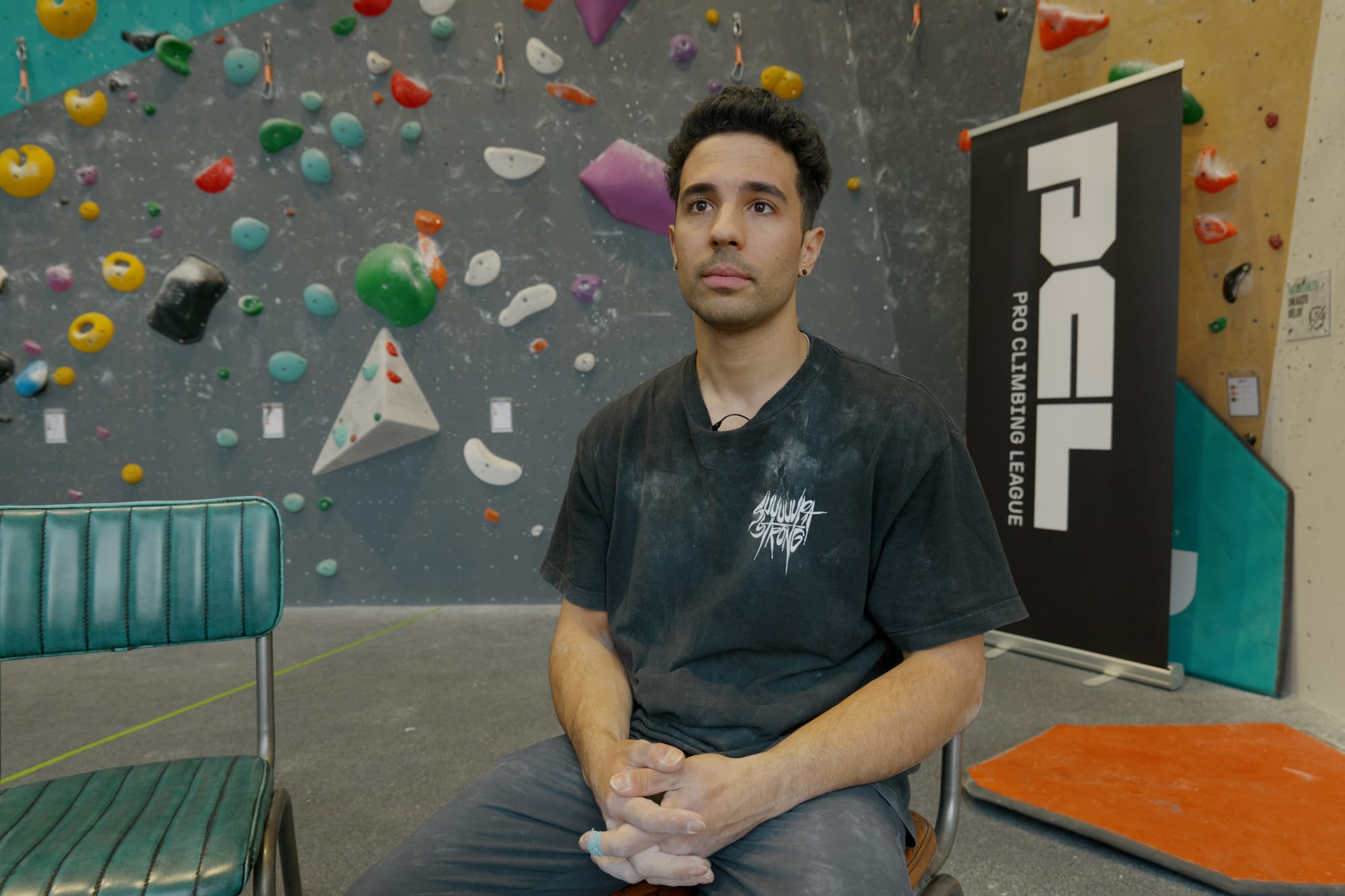
As part of the creator day before the event I talked with Sergio Verdasco, the Head Routesetter for the event.
Sergio is a World Climbing Level 5 routesetter, and has already been head routesetter for multiple World Cups and the 2024 European Championship. He was also one of the boulder routesetters for the Paris 2024 Olympic games and the Olympic Qualifier Series events.
Rory: You've been a head setter at World Cups. What are the big differences for you as a setting team between PCL and the World Cups?
Sergio: We don't really know yet because it's the first time. So this was the most tricky part of the set. In this event that we don't know how the climbers will react, where we should go with the boulder. So I think for the World Cup. Yeah, we know what to expect in this case. There is a lot of more stress.
Also, the strategy to rest, to brush, I think, is going to be not the same like in the in the normal World Cup since the first one to top is the winner. So we try to be similar to the World Cup semifinal. It was our target. We hope it was the good, the good, the level for the winners.
The scoring format is quite similar to lead in that every hold matters. How does that change the setting process for you compared to a normal World Cup boulder where you have a zone and a top?
For me, I like a lot because it means that every movement is important in the boulder. In the classic World Cup style sometimes we can accept some movement that they are a bit easier or the intensity go down in some places. Here we try to look for to aim for. Every movement is something and it was really interesting.
Of course it changed a bit the style for like coordination or technical style because it's a bit more tricky for the points. Or in this slab, for example, if you don't have hands, it's hard to get the points. But anyway, the walls are there a bit too steep, so there's not a lot of this.
How is it setting on those adjustable walls where you can, like, pick an angle and change a boulder?
It was quite useful for some problems because once we were almost finished, sometimes we decide to put one more degree or one less. Also during the beginning of the process, some movements were almost okay. It was just too hard, too easy. So we played with the angle and it was really good. So I think it was a useful tool, for the adjustments of the boulders.
Sometimes we don't have a lot of time between the runs. Our plan is to play with the degree. So yeah, I think is, is a nice, nice way.
How steep can you set the boulders?
Sadly only 35. I, I was motivated for 50, but we went we were allowed only to go to 35 because of cameras and also the wall. I hope in the future it will be more.
I talked with some climbers and they're both like, "I want a 60 degree kilter board" problem.
It is like this. This time I think it's going to be cool. I think it's going to be cool anyway, with the volumes, we try to create more steep when we need it. Yeah.
How is the hold selection you had?
The hold selection was a bit different to the World Cups. So it was brands that they are not every time on the World Cup. The brands are of course really top brands on high level, but we are used to use other brands more. So it was really interesting to work with new material. This I like a lot like these.
We can get new ideas. It was a bit tricky sometimes, but like with every call or every run. So yeah, I feel like it is nice to have a different hold selection and we enjoyed it.
You talked earlier about technical climbing. How tricky is it for this format to set really technical climbs on vert or slightly slabby?
It's okay because they will go until minus ten, I think. We went only up to zero. The thing is that we put one technical rule on the qualification because it's three boulders and then for semifinals, small final or big final is not technical because there's only one boulder of deciding all the round, so we choose different style.
We believed it was more accurate for to decide one wall round. So we decide different styles. But for qualy it was nice to have one technical rule.
Yeah. How did you how did it how does it feel setting a final which has only one boulder?
It was tricky already to decide who is sitting what, which feels a bit of pressure because normally when you said one boulder in the final of course is really important, but in this case is way more representative because it's only one boulder. I mean to represent all the final or all the semifinal. Of course, there is a lot of teamwork, but at the beginning of the process you are alone in the wall and you know it's all the finals here.
So for me, I felt a bit of new extra pressure, which is also really nice. There is a lot of new points on this comp that were really interesting for us.
What thing have you learned in this comp which has really helped you think about setting differently?
That every movement is important. I think this is something that we forget a bit because of the points, because it's only zone or top, or with the old Olympic format, it was two zones and then top, and sometimes we do with like waves in the boulder. I think is nice. It doesn't need to be every time homogeneous or going up above.
But for physical boulders I think is a really nice system. Like every movement is important. Because like it's also a bit easier for us. I think if every movement is hard or is something is a bit easier to regulate the boulder because if we do super easy and then one really hard movement is really hard to separate all of them in one movement. For us is really hard to know if is a good level, if it's too hard or it's just too hard for us.
But for them, it's been easy. So I like this style.
You had to repeat the boulders. Just how hard is that to get a boulder to be exactly the same and feel exactly the same?
Yeah. So in the World Cup, many times we replicate the boulders, but the qualification is different groups. So it's kind of two different competition. We try to replicate to save some time, but it's not a big deal if one is a bit harder on the other one because there are two rankings. In this case, we really needed to aim for the same boulder.
So Ian from Kilter, he had the system with a plastic and it was really interesting. So once we finish one boulder we unscrew a bit some screw. He put a plastic behind the holes and then we screw again. We mark the holes, and then since the wall is symmetric on both sides and there are t-nuts, it was really easy to to put the plastic on the same place, and then we put the holes.
So it was a really effective system. It was a bit tricky at the beginning to understand for us, but once we understood the system we realized it's really good. And then we of course we check they were minor mistakes sometimes because the hole moves or some holes are not completely the same sometimes.
So we need a small adjustment. But I think the boulders are really, really, really the same. I think we I'm yes I'm confident this is a this is totally fair. So this is really nice right.
You're going to get live strip and reset tomorrow. How do you feel about being on screen?
Being on the screen is okay. I'm more stressed about being on time because we only have ten minutes. The other day, we already did one test and tomorrow morning we are doing one more test. So the goal is really to be under ten minutes. For some boulders it's possible, but for other boulders it is really tricky.
So it's nice we have a big team helping us. We try to organize, to set a plan how to strip, how to reset. We hope it will work and I hope it's not superior dramatic if it is 11 minutes instead of 10, then the whole thing. But yeah, it's a bit stressful. I Normally no one falls from the ladder, but for sure tomorrow is not the day to fall from the ladder.
So being an F1 pit, changing the tires and you guys are doing that but with boulder problems.
It's true that in this competition already with the setting process and tomorrow during the event, there is a lot of things going on around and we are more used to be alone during our process. And then once they start up the climb, once they finish we go again but alone. And in this come they were always camera or many people because it is a really huge event.
So it was a bit different for us is we are not used to, we are more used to be on the back stage. Here these other things going on.
You guys are my favorite people. That's why I try and feature you, because I love chatting with groups, and I love hearing about you guys talk about climbing and how you think about it in all these different ways.
Because for me, to understand competition climbing, you need to understand routesetting.
And to understand routesetting is really hard!
Yeah. Really really hard. To understand the level, because you guys have an idea of what the level is, but you don't know, and it's really hard for you guys to know ahead of time. I'm always amazed how good a job you guys do.
Vezi one friend said one time "routesetting is a lot of guessing". And it's true that many times, we need to think how these will feel for them, but we are already three days on. They will be totally fresh and motivated for the comp. It is really hard sometimes to really try to regulate.
For example, today we didn't set on this round, on the seeding round, but we tested the boulders a bit just to have some information and it is true that they fill total different when the boulder is ready than when you are all in on the process. You know, you sometimes you try super hard version, then you go down and it feels already okay, but maybe it's still too hard. Yeah, do you never know?
Other media from me
- I chatted with Natalie Berry and Tyler Norton after the PCL event if you want to hear more about our reaction to the event. You can listen here or wherever you get your podcasts.
- The World Climbing Series and Para Series are starting soon and you can get live coverage of the events on my Instagram account. I create previews, detailed recaps, live results, links to live streams, and visualisations to help you understand the competitions.
- The World Climbing Series (WCS) Keqiao event/World Cup happened last weekend and I covered it live through my Instagram stories. Sorato Anraku claimed his 6th gold medal in boulder, joining Adam Ondra, Jan Hojer and Rustam Gelmanov on that mark. Zélia Avezou topped the final powerful boulder quickly to become the 8th French woman to win a boulder gold medal, beating Janja Garnbret by 0.2 points.
News Update
A brief news update of all of the recent news. Too much has happened since I last sent a newsletter, so I will try to include the most relevant.
- World Climbing announced an increase in prize money for World Cup events to €40K per event split across the top 8 athletes. This was tried out at a few events last year (Prague and Madrid) and was on the cards for this year by the time the World Championship in Seoul was happening. It is great to see the prize money increase, but climbing still lags behind many other similar sports. I plan to dive deeper into this in the near future.
- At the online Generaly Assemly, the World Climbing federations voted to have an extraordinary general assembly in July to discuss the geo-political situation. There had been plans to have a session focused on the geo-political situation at the 23rd General Assembly which was to be held in Riyadh, Saudi Arabia before moving online and the specific session postponed to December. The next in-person General Assembly is scheduled for 15 to 17 April 2027 in Saudi Arabia.
- World Climbing relaxed their rules on Russian and Belarusian athletes to allow them to compete as neutral athletes. These rules only require athletes to not have spoken out in support of the war in Ukraine and have no requirements on those athletes being supported by the Russian military. The list of athletes includes Viktoria Meshkova who won the European Championship in 2020 and competed at the Tokyo 2020 Olympics. It has been highlighted on Instagram by Ukrainian Olympian Jenya Kazbekova that many of these athletes hold ranks in the Russian military.
- Janja Garnbret confirmed that she is going to the Keqiao, Wujiang, Innsbruck, Koper and Santiago World Cups. She hasn't decided if she will do both disciplines in Innsbruck yet after spending the spring trying her main project Bibliography (9b+) (full interview in Slovenian).
Media I've enjoyed
When I started this newsletter, it was focused on listing the media I enjoyed and sharing it beyond. But the more I make, the less I consume and so instead of sticking to a rigid structure, I'll include a few pieces I particularly enjoyed.
- Jini talked to Director of Routesetting for the PCL, Jackie Hueftle on the That's Not Real Climbing Podcast.
- Max Bertone won both the French National Championship and the team selection event this year. Watch Emil Abrahamsson have a session with him at the Italian Training Centre in Arco, Italy.
- Hannah Morris did a Wired-style interview with several athletes at the PCL.
Ticket Update
Instead of including the whole list of competitions, I'm going to add in those which are coming up soon and any new tickets that are available.
- There are tickets still available for the Bern (May 31st), Prague (June 4th), and Innsbruck (June 15th) World Cups.
- The Madrid World Cup (May 28th) has sold out of their free tickets.
- VIP and seated tickets for the Chamonix World Cup are now available.
- Tickets for both the Lead and Speed European Championship in Laval, France, and the Para Series competition on August 28th are now on sale. The Boulder European Championship is being held in Barcelona on July 17-19, but ticket's don't appear to be available.
What is coming up next week ➡️
- Next weekend the Lead and Speed 2026 World Climbing Series kicks off in Wujiang, China.
- Next weekend look forward to a deep dive into what the World Cup Climbing Series has done in the past and where we are going this year.