

This week I look at where World Cups have gone over the years.
Since the World Cup circuit was first held in 1989, 74% of all World Cups have been held in Europe. Even since the IFSC (now World Climbing) was formed in 2007, 64% of competitions have still been held in Europe, with 24.7% in Asia and 10.9% across the Americas.
The 2026 season is not any different.
Of the 13 World Cups, 7 are in Europe (Bern, Madrid, Prague, Innsbruck, Krakow, Chamonix, and Koper), 4 in China (Keqiao, Wujiang, Guiyang, and Chongqing), and 2 in the Americas: 1 in Salt Lake City, USA, and 1 in Santiago, Chile.
No season has ever held more competitions outside Europe than inside it, and only twice — 2014 (8 events outside Europe) and 2025 (7 events) — has the split even reached 50/50. 2026 is still really close to the 50/50 split, with 54% of competitions happening in Europe.
To understand how we got here, we take a look at the continental, country and individual location level.
The European dominance can be mostly clearly seen at the continental level.
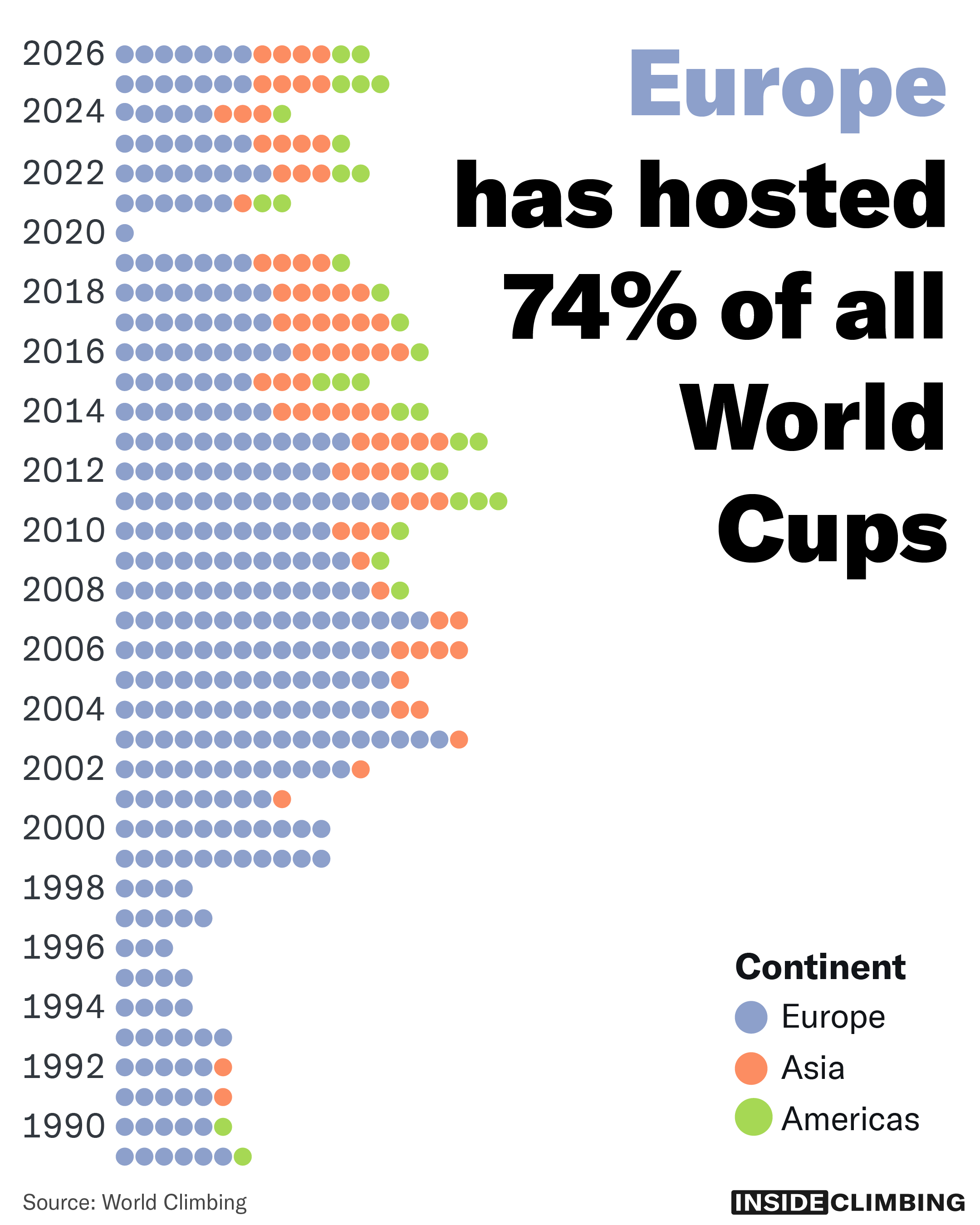
The chart above shows the number of competitions held on the World Cup circuit in Europe, Asia and Americas.
After hosting competitions in the USA in Snowbird and Berkeley in 1989 and 1990 before going to Tokyo and Kobe in 1991 and 1992, the World Cup stayed in Europe until it went back to Asia in 2001, going to Kuala Lumpur.
It wasn't until 2003 that China hosted its first World Cup. The World Cup didn't return to North America until 2008 when Vail, Colorado, started hosting World Cups regularly.
Last year was the first year ever the World Cup went to South America, going to Curitiba, Brazil. We return to South America for the last leg of the World Cup for a Speed and Lead event in Santiago.
Let's now zoom in to the country level. For years France and Italy hosted most of the World Cups in the 1990s and 2000s. In 2002 and 2003, Italy hosted 7 World Cups in each year. France hosted 4 in 1999 and 2000, and regularly hosted 3 World Cups until 2014 when it reduced to just Briançon and Chamonix.
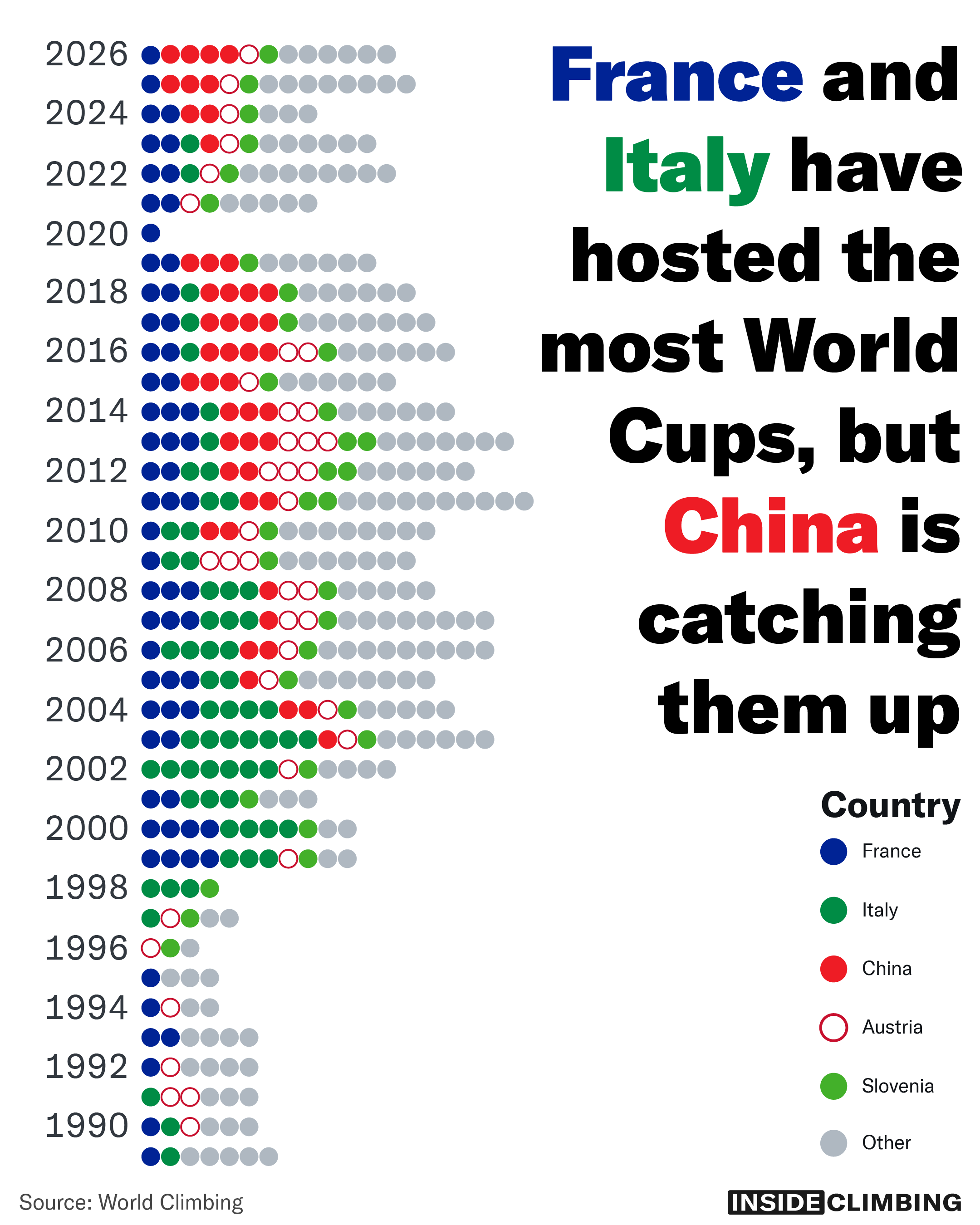
China didn't start hosting World Cups until 2003, and from 2013 onwards regularly hosted three or four per year until the COVID pandemic. The pandemic paused competitions in China, and the circuit didn't return until 2023.
In 2025, China hosted 3 World Cups after the Speed World Cup in Klagenfurt, Austria, was cancelled due to a sponsor pulleing out, and the competition moved to Guiyang
In 2026, China hosts 4 competitions, the first time it has done so since 2018. World Climbing also partnered with Bilibili, China's equivalent of YouTube, to stream all 2026 events as it looks to capture the millions of viewers in the country.
This year Chile becomes the 30th country to host a World Cup and the fourth in the Americas. So far there have been 17 countries from Europe, 9 from Asia and 3 from the Americas. Of those countries, only 5 have hosted just one World Cup. These are Brazil, Greece, Norway, Jordan and Ukraine.
Finally we zoom into the location level and see that small towns, often in the mountains, dominate.
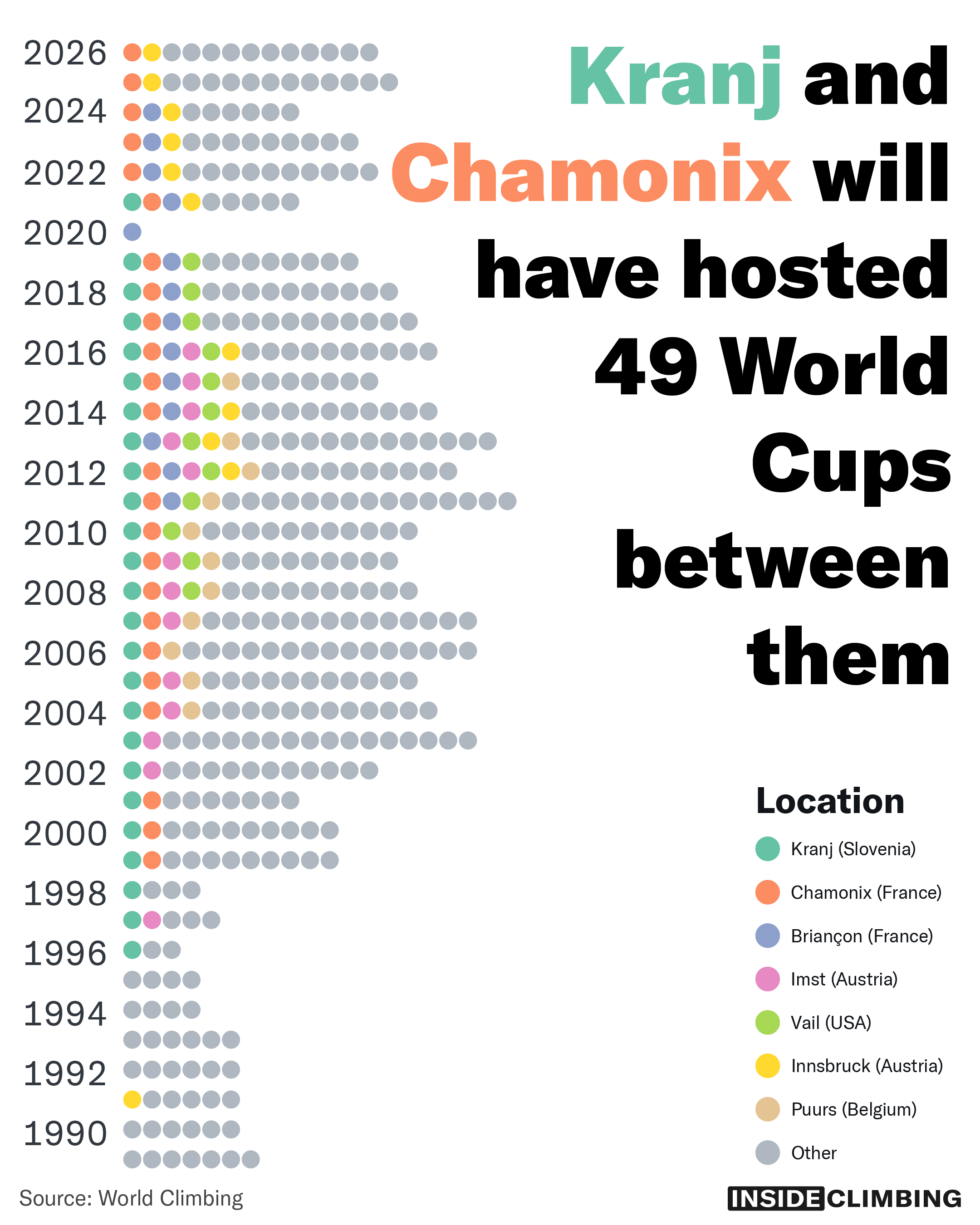
I hesitate to use city because for many years, the World Cups were hosted in ski towns with under 10,000 people. Chamonix is the only remaining destination, thanks in part to the 100,000 people who visit Chamonix over the summer months. It was estimated that over 18,000 people watched the Lead finals last year in Chamonix.
Kranj in Slovenia still holds the record for the number of World Cups held at 25 after holding the first one way back in 1996. But Chamonix has almost caught up to Kranj. This year will be the 24th World Cup Chamonix has ever hosted.
| Location | Country | Number of World Cups hosted | First year hosting | Last year hosting |
|---|---|---|---|---|
| Kranj | SLO | 25 | 1996 | 2021 |
| Chamonix | FRA | 24 | 1999 | 2026 |
| Briançon | FRA | 14 | 2011 | 2024 |
| Imst | AUT | 13 | 1997 | 2016 |
| Vail | USA | 12 | 2008 | 2019 |
| Innsbruck | AUT | 11 | 1991 | 2026 |
| Puurs | BEL | 11 | 2004 | 2015 |
| Wujiang | CHN | 11 | 2013 | 2026 |
| Birmingham | GBR | 9 | 1991 | 2006 |
| Chongqing | CHN | 9 | 2012 | 2026 |
The Kranj climbing wall was very old school, full of textures with athletes climbing into the rafters to reach the top. The World Cup moved from Kranj to Koper in 2022, keeping up the Slovenian tradition of hosting a World Cup every year (except 2020) since 1996.
Many of the other locations are in the mountains: Briançon was part of the lead triple of competitions along with Chamonix and Villars in Switzerland for many years. Imst is set in the mountains of Austria near Innsbruck. Vail in Colorado is another mountain town, and was the highest on the circuit at over 2,500 metres. Wujiang and Chongqing are the only locations with populations over a million when the World Cups were held there.
The World Cup circuit is still dominated by Europe, but it's a different circuit from what it was in 1989. Kranj and Chamonix have built 25-year traditions. China has grown from zero events to regularly hosting four in a season. The circuit keeps visiting new places and inviting more countries in, even if the centre of gravity hasn't moved that much.
News
- An interesting rule change for bouldering world cups this year is that ties are now split differently (see appendix B-1). Now, the number of attempts to top and attempts to zone are used to break ties after count back. This should reduce the number of ties in qualification, which was one of the biggest problems with the previous scoring format.
- The Wujiang World Cup happened this weekend, where we saw another upset, with Annie Sanders beating Janja Garnbret in the women's lead. Neo Suzuki came out first in the men's lead final, setting a high point that no one could get close to. He is the 5th athlete ever to climb first in a final and still win. The other four were Jorg Verhoeven (Zurich 2007, a 7-person final), Mina Markovic (Imst 2008), Sachi Amma (Chamonix 2014), and Hidemasa Nishida (Briançon 2019).
- The IOC announced that the Q-series, the final qualification pathway for the LA28 Olympics for 6 sports, will go to Tokyo, Shanghai, Montreal and Orlando. Climbing will feature at three of the four events. It has not been confirmed what competitions climbing will feature. About half the Olympic tickets will be awarded through the Q-series for climbing at the LA28 Olympics.
- One piece of news I didn't talk about last week, partially because I'm still dealing with the shock of it, was the arrest of USA Climbing speed coach Matthew Maddison for sexual exploitation of minors. The investigators allege that they have evidence going back to July of 2024.
I met Matthew at the OQS event in Budapest back in June of 2024 as part of the USA Climbing team and at Chamonix and Seoul last year. I only met him for a small period of time and squaring the circle between the person I met and the horrific allegations has really shocked me. My heart goes out to the whole of USA Climbing, for whom this must hit incredibly hard, and the speed climbing community.
Media
- Matt Groom is back with the World Climbing Club for each day of the past two events.
- Shauna Coxsey shared her CWIF experience and a debrief.
- Sam Richards shared a behind the scenes look at the first bouldering world cup of the season.
- Sofya Yokoyama shares how she approaches competition boulders.
Ticket Updates
- No new tickets have been released, but some tickets for Bern, Prague and Innsbruck are all still available. So are tickets for the European Lead & Speed Championship and the Para Series event in Laval.
- You can buy VIP and seated tickets for Chamonix.
- The Krakow event will be free to watch.
- Tickets for Koper aren't available, but they will likely be available from here.